This Review Reveals Minor Details About the Plot.
Coup de Grace

Plot Overview


 In the
aftermath of war, an authoritarian regime has arisen in
America. They confiscated privately owned guns, put the kibosh on
free speech, and restricted travel. Communism runs the place
resulting in a “lazy” population. A yearly motivational
walk has been instituted to spur workers to greater production. A
voluntary lottery selects one healthy male adult per state, 50 in
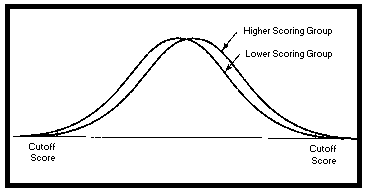
all, indicating a preserved Union at least. Every able-bodied man
being desperate enters it, but looking at the walker
demographics we see, as discussed by the literature of John
Paulos, the races did not fare equally.
In the
aftermath of war, an authoritarian regime has arisen in
America. They confiscated privately owned guns, put the kibosh on
free speech, and restricted travel. Communism runs the place
resulting in a “lazy” population. A yearly motivational
walk has been instituted to spur workers to greater production. A
voluntary lottery selects one healthy male adult per state, 50 in
all, indicating a preserved Union at least. Every able-bodied man
being desperate enters it, but looking at the walker
demographics we see, as discussed by the literature of John
Paulos, the races did not fare equally.

 There are no Jews or
Hispanics in it, which latter obviates the need for Spanish
translation of the event announcements. There's only one Asian-American,
but his short stride makes it hard for him to keep up. A
few nerds also drop out early. The walkers are almost entirely
White or black-Caucasians who persuaded white America to go easy on
them. Their Negro representation increases its percentage as
more flaccid Whites drop out. There's only one married man in the
five-man phalanxes, women being reluctant to marry men with such
limited prospects, this one wife Clementine having taken advantage
of the spotty competition. The final heat consists of three entrants:
Stebbins #38 (Garrett Wareing) who had a hard life, nobody there to help
him, Raymond Garraty #47 (Cooper Hoffman) with a good Irish work ethic who
along with the other has strong family motivation to continue, and black
Peter McVries #23 (David Jonsson) who having been worked like a slave all
his life has the endurance to prevail.
There are no Jews or
Hispanics in it, which latter obviates the need for Spanish
translation of the event announcements. There's only one Asian-American,
but his short stride makes it hard for him to keep up. A
few nerds also drop out early. The walkers are almost entirely
White or black-Caucasians who persuaded white America to go easy on
them. Their Negro representation increases its percentage as
more flaccid Whites drop out. There's only one married man in the
five-man phalanxes, women being reluctant to marry men with such
limited prospects, this one wife Clementine having taken advantage
of the spotty competition. The final heat consists of three entrants:
Stebbins #38 (Garrett Wareing) who had a hard life, nobody there to help
him, Raymond Garraty #47 (Cooper Hoffman) with a good Irish work ethic who
along with the other has strong family motivation to continue, and black
Peter McVries #23 (David Jonsson) who having been worked like a slave all
his life has the endurance to prevail.


 During a
walk of over 300 miles we get to observe the scenery. From time
immemorial peasants have been observed working their fields, but
here we see lots of fields but only one man on a tractor …
just sitting there. There are three horses fenced but running free
and an easily maintained field of sunflowers. A shop in town
is closed. People just lounge about where they are, and the
troopers in their armored vehicles have an easy job managing the
sheeple at their walking pace. It's no surprise they are called
lazy when they don't get to partake directly of the fruit of their
labor, and then there's the taxes. As authoress Deborah
Schupack puts it, “Lots of better things for a big,
healthy kid to do than standing around” (214).
During a
walk of over 300 miles we get to observe the scenery. From time
immemorial peasants have been observed working their fields, but
here we see lots of fields but only one man on a tractor …
just sitting there. There are three horses fenced but running free
and an easily maintained field of sunflowers. A shop in town
is closed. People just lounge about where they are, and the
troopers in their armored vehicles have an easy job managing the
sheeple at their walking pace. It's no surprise they are called
lazy when they don't get to partake directly of the fruit of their
labor, and then there's the taxes. As authoress Deborah
Schupack puts it, “Lots of better things for a big,
healthy kid to do than standing around” (214).


 The rules of this walk are
simple but brutal: “If you fall below the speed of three
miles per hour, you get your ticket [punched.] Walk until there's
only one of you left.” There are warnings first before
slowpokes are eliminated, but no warnings for leaving the
pavement; a carabinier just clears your ticket. “There's one
winner and no finish line.” The prize is an obscene amount of
money and one wish granted.
The rules of this walk are
simple but brutal: “If you fall below the speed of three
miles per hour, you get your ticket [punched.] Walk until there's
only one of you left.” There are warnings first before
slowpokes are eliminated, but no warnings for leaving the
pavement; a carabinier just clears your ticket. “There's one
winner and no finish line.” The prize is an obscene amount of
money and one wish granted.
Ideology

 As the walkers near the end they discuss this wish one of them
will get. A previous winner asked for a pet elephant and they gave
him one. A white elephant is a gift whose maintenance is so
extravagant as to exceed the worth of the gift itself. But they
give you what you ask for as long as it doesn't undermine society.
As the walkers near the end they discuss this wish one of them
will get. A previous winner asked for a pet elephant and they gave
him one. A white elephant is a gift whose maintenance is so
extravagant as to exceed the worth of the gift itself. But they
give you what you ask for as long as it doesn't undermine society.
One of them says he'll wish for ten naked women to come home to. Black McVries #23 castigates him for wishing for something he could easily just buy; with all the money he'd get, he could have ten naked women every night. One should wish for something money can't buy.
Both Stebbins #38 and Garraty #47 contemplate wishes that are within allowable parameters—technically—and can't be bought. In fact there is some doubt they'd be allowed to keep their prize money if they got either of those wishes, but being white and winners they'd take their chances.
The relevant Bible passage regarding get rich quick schemes is, (Prov. 30:7) “Two things have I required of thee; deny me them not before I die:”
(Prov. 30:8-9) “Remove far from me vanity and lies: give me neither poverty nor riches; feed me with food convenient for me: Lest I be full, and deny thee, and say, Who is the LORD? or lest I be poor, and steal, and take the name of my God in vain.” The thief might be tempted to swear in God's name he didn't take it. There's a lot of propaganda (“vanity and lies”) associated with the long walk, but nobody they pass seems to be starving, and if they all worked harder, they'd all do better. Garraty says, “Rich men don't enter the kingdom of heaven. I'm no money freak.” Yes, but maybe he'd forget about God or his ways if his fortune changed. When his boots wore out, he cast them off making him dirt poor. Feet can stray seemingly on their own volition. And if he gets his wish on false pretenses, that would be stealing.
Who knows how author Stephen King will end it? He's never short on surprises.
Production Values
“” (2025) was directed by Francis Lawrence. It was written by JT Mollner and Stephen King under his pseudonym Richard Bachman. It stars Cooper Hoffman, David Jonsson and Garrett Wareing. The acting was excellent, especially from the two leads Cooper Hoffman (as Raymond Garraty) and David Jonsson (Peter McVriess.) It had to be to make the movie work.
MPA rated it R for strong bloody violence, grisly images, suicide, pervasive language, and sexual references. It's the kind of movie you don't send the kids to. It is technically well made in a dark sort of way. It was filmed on location in Garson, Manitoba, Canada. It has a running time of 1 hour & 48 minutes.
Review Conclusion w/a Christian's Recommendation
This one is pro-family values and anti-Communism in hard times. The countryside had horses but no cows, a church but no congregation, and a race but no second place.
It was third on my list of possible Friday flicks, but I couldn't get tickets for the other two, so I went to this one although I generally find Stephen King too disturbing for my tastes. To each his own.
Movie Ratings
Action factor: Decent action scenes. Suitability For Children: Not Suitable for Children of Any Age. Special effects: Average special effects. Video Occasion: Good for a Rainy Day. Suspense: Don't watch this movie alone. Overall movie rating: Four stars out of five.
Works Cited
Scripture is taken from the King James Version. Pub. 1611, rev. 1769. Software, Print.
Paulos, John Allen. The double normal distribution graph was taken from his, A Mathematician Reads the Newspaper. New York: BasicBooks, 1995. Web.
Schupack, Deborah. The Boy On the Bus. Copyright © 2003 by Deborah Schupack. New York: Simon and Schuster. Print.


 bibles.n7nz.org